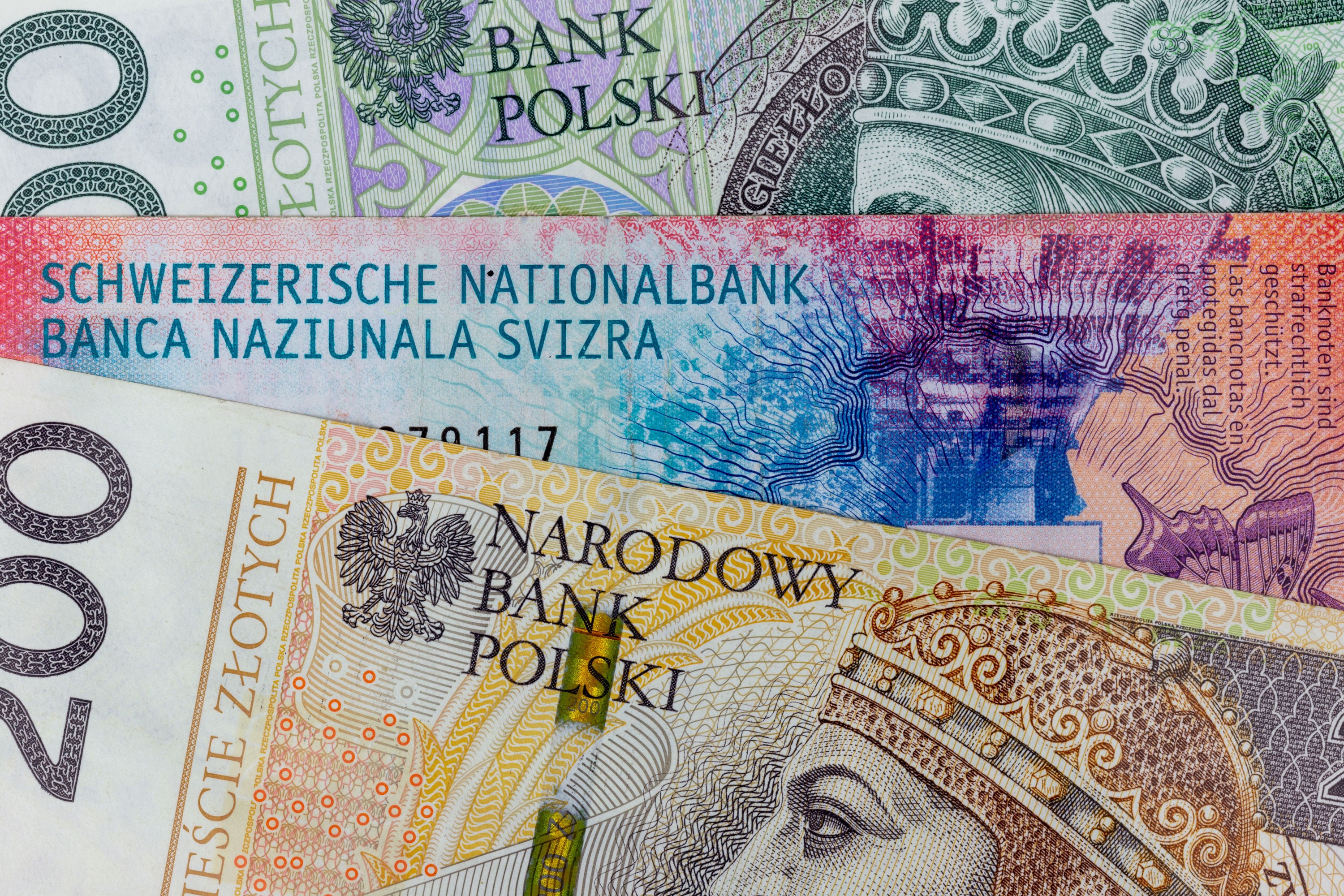
Trade with Poland: a practical guide to CHF/PLN payments
Poland is part of the EU but still uses the Polish złoty. For Swiss businesses, choosing between PLN, EUR and CHF changes where currency conversion happens, how payments move and who carries the FX exposure.
Practical guide
Posted on:
Poland is one of the most important Central European markets for Swiss businesses, but a Polish invoice is not automatically a euro transaction. A company may agree the price in Polish złoty (PLN), euros or Swiss francs. That choice affects the payment route, the point of conversion and the currency exposure on each side of the transaction.
Poland is a member of the EU, but not the Euro area, so the złoty remains the national currency
Poland joined the European Union in 2004, but it is not a member of the euro area and does not use the Euro. The European Commission confirms that the złoty remains the national currency. This is important from an operational point of view: EUR may be convenient for cross-border trade, but it is not necessarily the final currency a Polish supplier or customer needs for domestic costs and revenues.
The currency also has a long history. The name złoty means “golden” in Polish and dates back to a monetary tradition that predates the modern Polish state. The National Bank of Poland traces the use of the złoty in Poland to the late Middle Ages. The latest BIS Triennial Survey, based on trading activity in April 2025, shows that the Polish złoty is the most traded of the major Central and Eastern European currencies, with average daily OTC FX turnover of about USD 74 billion, compared with USD 39 billion for the Hungarian forint and USD 36 billion for the Czech koruna.
The commercial relationship is substantial. According to the Swiss Federal Department of Foreign Affairs, Poland is Switzerland’s most important export destination in Central Europe. Bilateral goods trade reached just under CHF 6.5 billion in 2025, excluding gold. More than half of Swiss exports to Poland come from the machinery, electrical equipment and metals, chemical and pharmaceutical industries.
Trade in originating industrial goods is also supported by the Switzerland–EU Free Trade Agreement, which provides duty-free trade for qualifying industrial products between Switzerland and the EU. The agreement does not remove the need to decide how the commercial currency and payment flow should be structured.
PLN, EUR or CHF? Start with the invoice currency
The invoice currency determines which party needs to convert funds and when FX exposure begins. For a Swiss importer whose cash is mainly in CHF, the three common approaches create different chains.
Invoice currency | Likely conversion point | Main question to check |
|---|---|---|
PLN | Swiss buyer converts CHF → PLN before payment | What CHF/PLN rate and timing will apply? |
EUR | Swiss buyer may convert CHF → EUR; supplier may later convert EUR → PLN | Will EUR actually be retained or used in Poland? |
CHF | Polish supplier may convert CHF → PLN after receipt | How is the supplier pricing its own conversion risk and cost? |
A PLN invoice creates a direct CHF/PLN exposure for the Swiss importer until the required złoty are purchased. An EUR invoice shifts the visible exposure towards CHF/EUR, but the Polish supplier may still need to convert the proceeds into PLN. A CHF invoice transfers more of the conversion task to the supplier. In each case, the currency risk has not necessarily disappeared; it may simply sit with a different party.
For a Swiss exporter, the direction reverses. Invoicing a Polish customer in PLN makes the local payment simpler for the customer but leaves the Swiss company exposed until the PLN is held, used or converted. Invoicing in CHF or EUR transfers more of that exposure to the customer. The commercial price and the settlement currency should therefore be negotiated together.
One invoice, different payment routes
1. EUR route: convenient when EUR is part of the commercial setup
Possible route: CHF → EUR → EUR payment → supplier retains EUR or converts EUR → PLN.
A EUR invoice may suit a supplier that already prices purchases, exports or financing in euros. It can also allow a euro payment route such as SEPA where the account setup is eligible. But if the supplier ultimately needs PLN for payroll, taxes or domestic costs, another conversion may still occur after receipt.
Tip: The buyer should therefore compare the supplier’s EUR and PLN commercial terms rather than assuming that the EUR route is automatically simpler or cheaper.
2. CHF route: simple for the buyer, but the supplier may need to convert
Possible route: CHF → Polish supplier → possible CHF/PLN conversion.
A CHF invoice can remove an immediate conversion from the Swiss buyer’s workflow. The Polish counterparty then decides when and where to obtain PLN. If it carries the conversion cost or exchange-rate uncertainty, it may reflect that in its quoted price or payment terms.
Tip: This is a commercial question, not a universal outcome, so the CHF and PLN quotations should be compared on the same basis.
3. PLN route: convert and send PLN through a local payment route
Possible route: CHF → PLN → local PLN payment → PLN credited to the supplier.
SwissFx currently supports local and international PLN payments and collections. A Swiss business can convert CHF into PLN, hold the balance and send the payment through a domestic PLN route. This gives the buyer greater visibility over the amount sent in the supplier’s local currency and can avoid leaving an additional conversion to happen after the payment is sent.
Tip: PLN is not always cheaper than EUR or CHF
The relevant comparison is the supplier’s price, each FX conversion and margin, any payment charges or deductions, and the final amount credited.
You collect PLN? Look at both sides of the flow
Possible collection route: Polish customer → local PLN payment → PLN collected → held, used or converted.
A Swiss exporter with Polish customers faces the reverse payment question. With local PLN collection, the customer can pay in its domestic currency while the Swiss company receives PLN within a multi-currency account. The company can then decide whether to convert the funds into CHF, keep them for a planned conversion or use them against recurring PLN costs.
Looking at both sides of the flow can reduce unnecessary back-and-forth conversions.
If PLN revenue and PLN expenses are managed separately, the company may convert incoming PLN into CHF and then later buy PLN again for supplier payments.
Example: PLN 500,000 of revenue against PLN 800,000 of supplier costs
Consider a Swiss manufacturer that each quarter pays approximately PLN 800,000 to a Polish component supplier and collects approximately PLN 500,000 from Polish customers.
" height="40px" id="Q_odDPqUH" width="40px"/><path d="M 20.87 6.957 L 13.913 6.957 L 13.913 0 L 6.956 0 L 6.956 6.957 L 0 6.957 L 0 13.913 L 6.956 13.913 L 6.956 20.87 L 13.913 20.87 L 13.913 13.913 L 20.87 13.913 Z" fill="rgb(240, 240, 240)" height="20.86953125000001px" id="Bjm8exMq6" transform="translate(9.57 9.57)" width="20.869531249999994px"/></g></svg>)
By keeping the PLN 500,000 and using it for the supplier payment, the company only needs to obtain the net PLN 300,000 shortfall. This is a form of natural hedging: inflows and outflows in the same currency offset part of the gross exposure.
It does not remove a remaining net exposure, and it only works to the extent that amounts and payment dates line up.
Manage the residual CHF/PLN exposure
In the example above, the company’s actionable FX requirement is the PLN 300,000 shortfall rather than the full PLN 800,000 supplier invoice.
If the payment is imminent, a spot conversion may be appropriate.
If the company already holds PLN, it can use that balance.
If the amount and payment date are sufficiently certain, it may assess whether an eligible deliverable forward contract fits the underlying transaction.
A deliverable forward fixes the exchange rate for a future CHF/PLN conversion, which can improve budget predictability. It remains binding even if the market later moves in the company’s favour. SwissFx offers PLN among the currencies available for deliverable forwards. Its FX risk management tools are subject to eligibility, the certainty of the underlying commercial exposure and the proposed structure.
Compare the commercial outcome, not only the transfer fee
The lowest visible transfer fee does not necessarily produce the best commercial result. The comparison should begin with the supplier or customer price and then follow the money through every conversion and payment stage.
If the Polish supplier offers different PLN, EUR and CHF prices, compare those prices before adding the payment and FX costs on the Swiss side.
Managing PLN payments and collections together
For Swiss businesses trading with Poland, the most appropriate setup depends on where conversion takes place, who carries the FX exposure and whether PLN receipts can be reused for local payments. Matching PLN inflows and outflows can reduce the amount that needs to be converted from CHF, leaving the business to manage only the residual CHF/PLN exposure.
SwissFx enables businesses to manage CHF, EUR and PLN within a multi-currency account, with local PLN payment and collection routes available among its supported currencies. Where appropriate and subject to eligibility, businesses can also explore FX risk-management solutions for future CHF/PLN requirements with their dedicated relationship manager.
This article is for general educational purposes only and does not constitute financial advice. FX risk-management products are subject to eligibility, availability and the underlying commercial exposure.
Do you trade with Poland?
Let’s review your current PLN setup. SwissFx can assess how you pay suppliers, collect customer payments and manage CHF/PLN conversions, and explore whether a different setup could better fit your business flows.